
Automated Warehouse System Design
Background
Symbotic needed to optimize their next-generation automated warehouse design for maximum productivity and efficiency in multimodal robotic warehousing operations.
Model Purpose
SDI worked with Symbotic to help design their "Warehouse of the Future" through comprehensive simulation modeling and optimization, developing AI algorithms and digital twin capabilities.
Key model inputs
- Robotic system specifications and performance parameters
- Facility layout alternatives and constraints
- Task orchestration and inventory positioning strategies
- System balancing requirements across multiple operational modes
Key Experiment Factors
- Facility layout optimization scenarios
- Task orchestration algorithm alternatives
- Inventory positioning strategy evaluation
- Global system balancing approaches
System Performance Measures
- Overall warehouse productivity and throughput
- Robotic system utilization and efficiency
- Task completion times and system responsiveness
- Operational cost and performance trade-offs
Model View
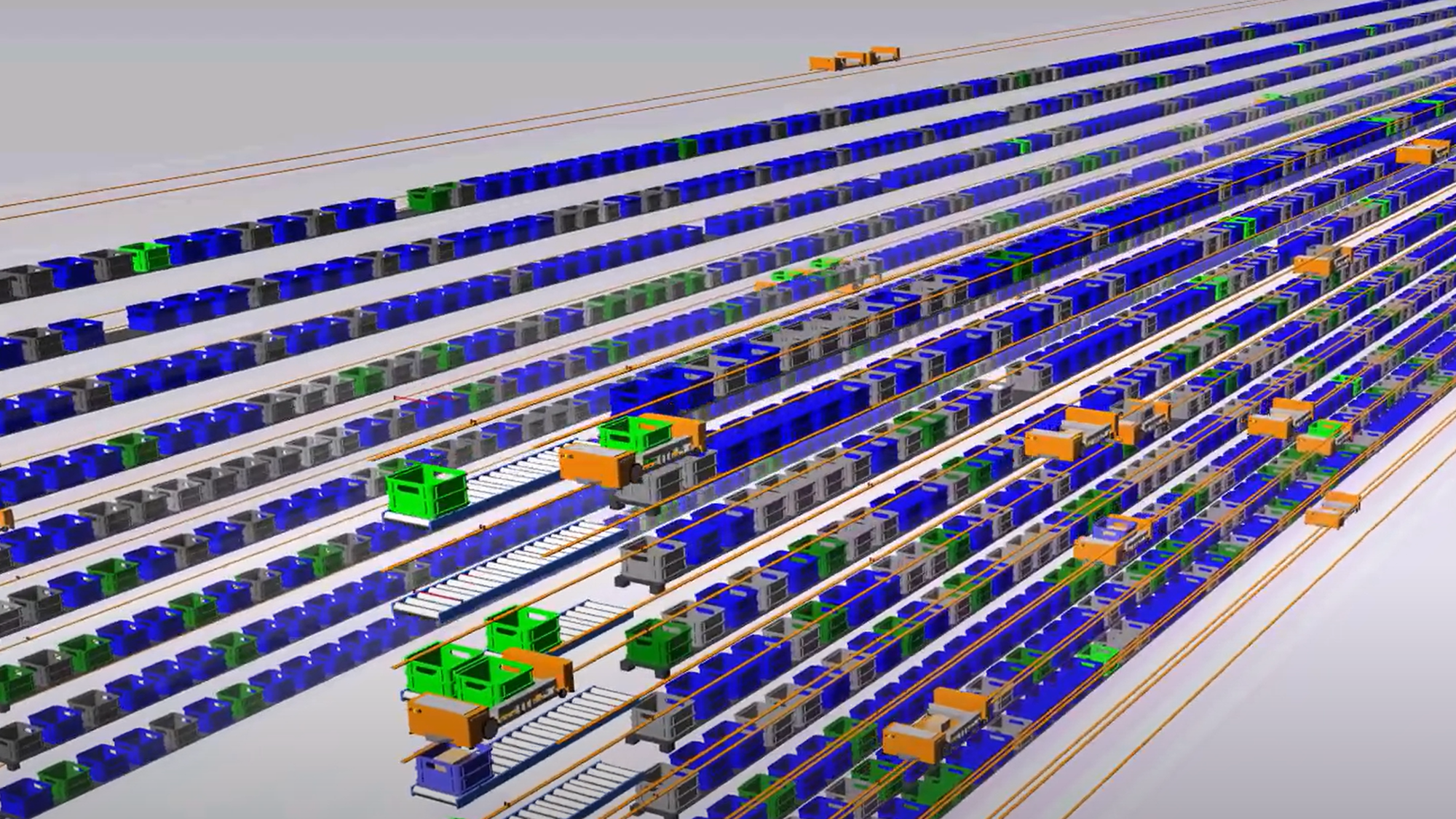
The following screenshot shows this model mid-state. Click here to see the full animation.
Project Results
This collaboration involved developing AI algorithms and digital twin capabilities to simulate and diagnose performance issues, optimize global system balancing, facility layout, task orchestration, and inventory positioning.
-
94% productivity improvement in multimodal robotic warehousing achieved through SDI's simulation expertise
-
AI algorithms and digital twin development for automated systems
-
Design optimization for next-generation warehouse automation
-
Simulation-optimized facility layout enabling breakthrough productivity gains
-
"Bob and Spencer were excellent simulation engineers. They were careful and thorough with understanding our issues. Their simulation was developed with alacrity and accuracy. The SDI team went above and beyond the project scope, proactively brainstorming ways to make our project better." - J Adam Traina, Director of Operations Research, Symbotic
Industry Recognition
Featured in Wall Street Journal as "Warehouse of the Future" demonstrating the impact of simulation-optimized design on warehouse automation.
Strategic Assessment
The following list provides links to articles within this document that address strategic assessment issues related to this case study:
- Manufacturing: Capacity Analysis Ability of automated systems to handle projected throughput requirements with validation through simulation modeling.
- Resource Management: Long Term Resource Requirements Assessment of long term resource requirements and operational costs for automated warehouse systems.
- Resource Management: Network Capacity Assessment of the capacity of automated networks to carry specified material flows under various operational scenarios.
Process Partners Innovation Collaboration
Background
SDI strategically partners with Process Partners and Jim Breslin to develop breakthrough manufacturing technologies that neither organization could create alone.
Breakthrough Cereal Manufacturing Technology
The Innovation: Jim Breslin's patented decoupling technology addresses a key bottleneck in flaked cereal production lines where cooker capacity exceeds oven throughput. By enabling manufacturers to shelf-stabilize partially-cooked corn grits and continue processing (flaking) at different locations or times, this approach could save tens of millions of dollars industry-wide.
SDI's Contribution: Built the Decoupling Simulator, a comprehensive production simulation tool built on ReliaSim's Discrete Rate Simulation engine. The simulator models the entire production flow — 12 parallel cookers, hot temper surge bin, 16 mills, 4 ovens, and decoupling modules (off-ramp dryer, tote storage, on-ramp feeder) — using rate-based dynamics rather than individual units, enabling annual scenarios to run in seconds.
Live Demonstration: Decoupling Simulator - Interactive cloud-based simulation demonstrating SDI's Model-Based Applications approach. Users can adjust on/off-ramp machines, tote storage capacity, transfer rates, surge bin size, and downtime parameters to explore alternative process flows.
Model Purpose
To enable technology inventors to collaborate directly with customers, allowing decision-makers to explore production system implications and quantify the impact of storage and buffering systems before implementation — using business language rather than simulation terminology.
Key model inputs
- Real production data including 1-year Vitamin Weigh Belt history
- Production system parameters for cooking, stabilization, and decoupling processes
- Warehouse capacity and storage requirements
- Investment cost parameters for equipment sizing
System Performance Measures
- Cooker utilization profiles, production curves, packaging loads, and inventory levels
- 1% efficiency accuracy validated against real production data
- 1,200x faster than legacy discrete event tools
- Potential to increase production by 20% or more during peak periods
Project Results
The Decoupling Simulator enables technology inventors to design and size systems for various operating conditions, identify substantial throughput improvements, and explore options directly with customers through the cloud-based model.
- Substantial throughput improvements identified with high confidence level of attainment
- Direct customer collaboration through business-friendly simulation interface
- Investment decision support accessible to business leaders without simulation expertise
- Technology validation and sizing support through interactive scenarios
- Living demonstration of Model-Based Applications methodology
Strategic Assessment
The following list provides links to articles within this document that address strategic assessment issues related to this case study:
- Supply Chain: Postponement Moving production operations downstream, closer to the customer in space and time through innovative manufacturing processes.
- Manufacturing: Operational Strategies Impact of new operational strategies enabled by breakthrough manufacturing technology on throughput and resource utilization.