
Case Studies: Manufacturing
The following case studies illustrate SDI's manufacturing simulation work:
Case Studies
- Chemical Packaging Modelassessment of alternative bagging line configurations and scheduling parameters
- Food Processing Capacity Optimization15% throughput improvement through scheduling optimization
Chemical Packaging Model
Background
Simulation Dynamics built a model to help a chemical manufacturer assess alternative bagging line configurations. In addition to initial experimentation done by SDI, the manufacturer has used the model on an ongoing basis for schedule and production assessments.
Model Purpose
- Determine tradeoff between cost of alternative bag line configurations and overtime cost
- Evaluate alternative scheduling parameter combinations in terms of inventory levels and overtime cost.
Key model inputs
- Alternative demand and forecast scenarios; i.e., a stream of customer orders drives the model.
Key Experiment Factors
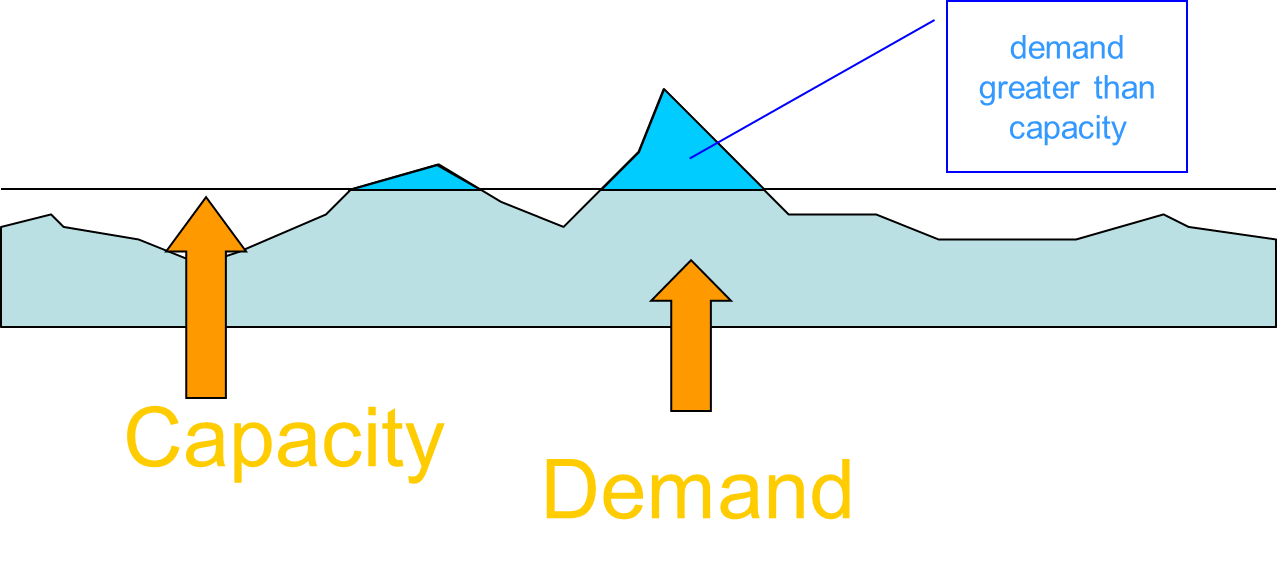
- Alternative demand scenarios; e.g.,
-
Alternative scheduling parameters
-
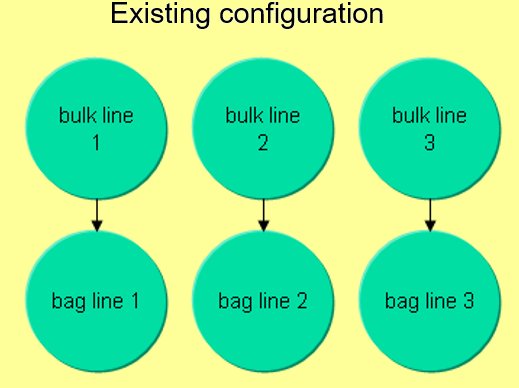
Alternative bagging line configurations. In the current setup, bag lines are tied to bulk manufacturing lines:
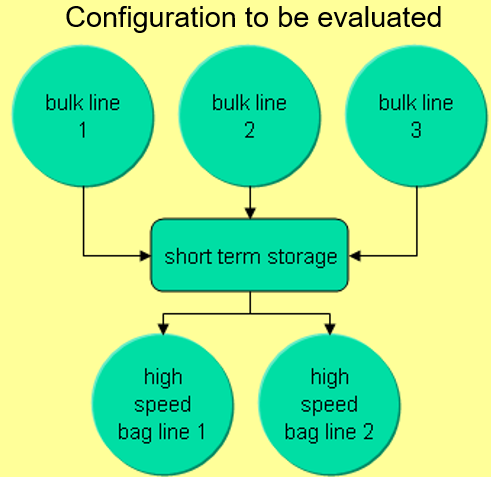
The "To-Be" configuration decoupled this tie, by introducing some short-term storage:
Critical Measurement: Overtime required under each bagging line scenario.
System Performance Measures
- Total inventories
- Customer order fill rate
- Overtime hours
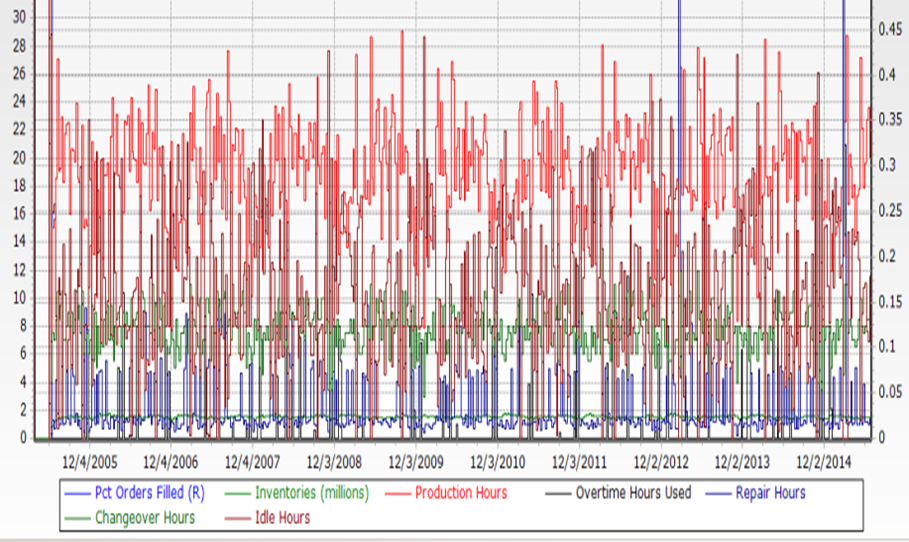
Plot of Bag Line Activity
Average weekly hours (production, repair, changeover, idle, overtime for a 10-year experiment horizon):
Project Results
The modeling revealed options for business growth that weren't readily apparent through traditional analysis methods. Our ability to handle both manufacturing complexity and supply chain interactions provided comprehensive insights for the restructuring decisions.
"We have uncovered additional options for low capital cost business growth, some of which were not readily apparent beforehand." — Rick Dougherty, Senior Manufacturing Analyst, Rohm & Haas (Dow Chemical)
Strategic Assessment
The following list provides links to articles within this document that address the strategic assessment issues related to this case study:
- Production Capacity A central issue in the chemical packaging model was the need for overtime. The tradeoff between capital cost of increased capacity and the cost of overtime was assessed.
- Safety Stock Design Safety stock was set at customer facing inventories using the basic calculation, without modification.
- Postponement In the current production scenario, packaging lines are dedicated to bulk production lines and must pack off product as it is produced. The future scenarios being considered introduce bulk storage between bulk production and packaging, with new high speed packaging lines that could operate on a different schedule from bulk production. This form of postponement allows greater flexibility in scheduling of production and packaging resources.
Food Processing Capacity Optimization
Background
An olive processing company needed to understand its true production capacity. The facility was large and complex, with unclear bottlenecks and scheduling challenges that were limiting throughput.
Model Purpose
To develop a detailed simulation model that revealed the dynamics of material flow, identified capacity constraints, and tested various scheduling approaches while quantifying the effects of natural variability in olive processing.
Key model inputs
- Historical production data and processing rates
- Equipment reliability and maintenance schedules
- Harvest variability patterns
- Current scheduling policies and constraints
Key Experiment Factors
- Alternative scheduling approaches including Theory of Constraints methodology
- Capital expenditure scenarios for equipment upgrades
- Impact of harvest variability on throughput
- Buffer sizing and inventory management strategies
System Performance Measures
- Overall throughput and capacity utilization
- Bottleneck identification and quantification
- Capital investment return analysis
- Schedule robustness under variability
Project Results
This decision tool was effective for both capital expenditure decisions and formulation of scheduling policy. The simulation confirmed suspected bottlenecks and revealed that a Theory of Constraints-based scheduling system could significantly improve performance.
-
15% throughput improvement through scheduling optimization
-
Capital expenditure decisions validated through simulation before implementation
-
Better understanding of harvest variability impacts on production planning
-
Implementation of daily TOC-based scheduling system
-
Risk-free validation of proposed changes before costly implementation
-
"The model confirmed bottlenecks at certain operations in the plant... an effective tool to evaluate proposed capital expenditures and scheduling changes over short and long-term periods." - Robert Rugeroni, IT Director
Strategic Assessment
The following list provides links to articles within this document that address strategic assessment issues related to this case study:
- Manufacturing: Capacity Analysis Ability of current or anticipated capacity to handle projected product mix with validation of capital investment decisions.
- Manufacturing: Operational Strategies Impact of new operational strategies including Theory of Constraints scheduling on throughput and resource utilization.
- Supply Chain: Production Capacity Strategies for dealing with periods of demand over capacity including scheduling optimization approaches.